



Comments
Clever Design Creates Optical Illusion to Upscale This House
Inspired by pop artist Roy Lichtenstein's dots, ventilation blocks were used to give the illusion of height and depth

Chiquit Brammall
19 December 2021
Design journalist and freelance editor. Dollhouse architect. Serial renter.
When their next-door neighbour renovated their semi-detached house, it dwarfed their house – and convinced the homeowners to embark on their own renovation. They commissioned Studio Wills + Architects to make their house appear taller than the permissible maximum height of 13.1 metres, and more substantial than their neighbour’s.
Photos by Beton Brut
Houzz at a Glance
Who lives here: A couple, their teenaged son, and a domestic helper
Location: Katong
Size: Approximately 4,500 square feet (418 square metres), with 4 bedrooms
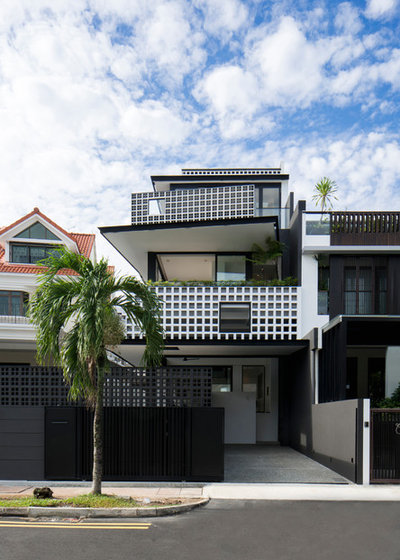
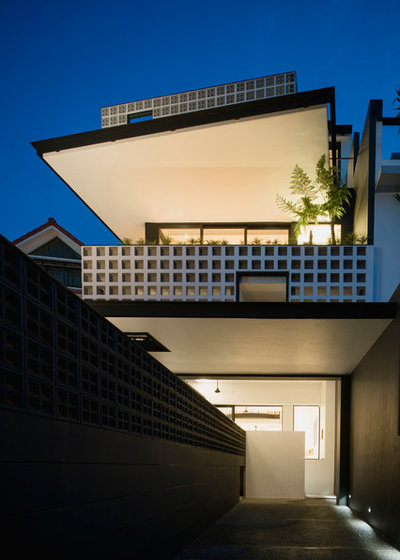
Architects William Ng and Kho Keguang worked on the project, technically classified as A&A (Addition & Alteration). With the original structure being set back a fair bit from the front entrance of the lot, the architects transformed the facade with an extension made of perforated boxes on floating planes. The built-up area grew by 1,420 square feet from its original 3,078 square feet.
Houzz at a Glance
Who lives here: A couple, their teenaged son, and a domestic helper
Location: Katong
Size: Approximately 4,500 square feet (418 square metres), with 4 bedrooms
Architects William Ng and Kho Keguang worked on the project, technically classified as A&A (Addition & Alteration). With the original structure being set back a fair bit from the front entrance of the lot, the architects transformed the facade with an extension made of perforated boxes on floating planes. The built-up area grew by 1,420 square feet from its original 3,078 square feet.
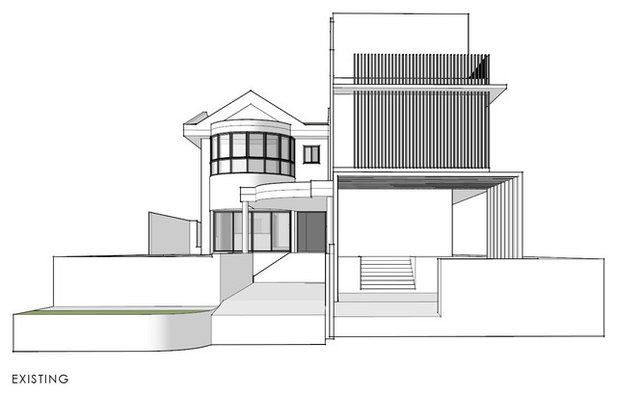
Before: The contemporary house on the right is the neighbour’s revamped look; the house on the left was the original design for this pair of mirror-image semi-detached houses.
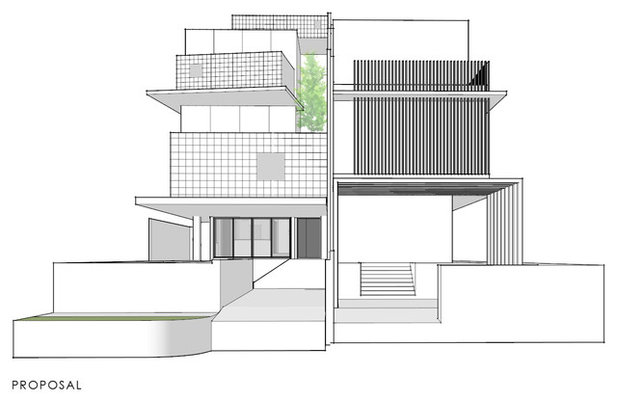
Studio Wills + Architects’ proposed design was to scale up to the maximum height allowed vis-a-vis the party wall. A pocket garden nestled between the party wall and the extension visually cuts the bulk of the building, and at the same time brings sunlight and ventilation to the inner recesses of the house.
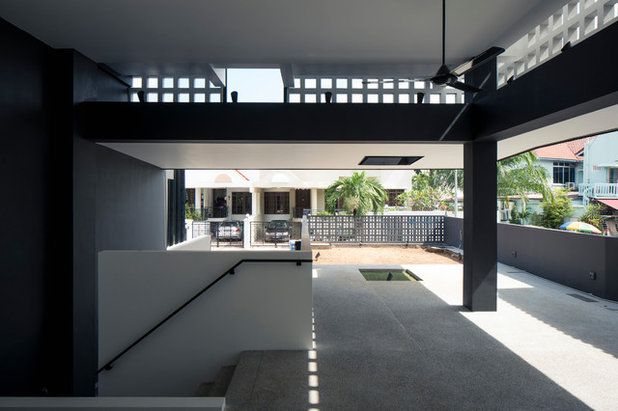
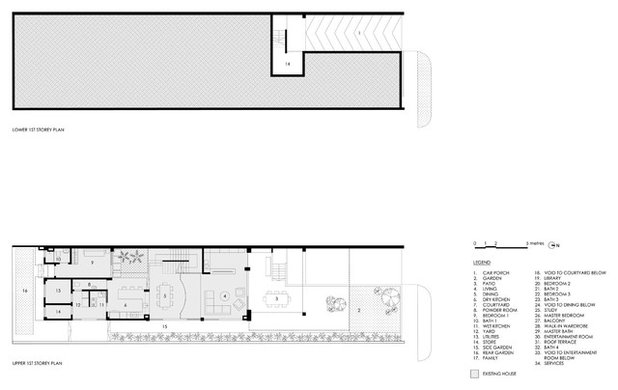
With the ground floor functioning largely as a carpark and service area, the first storey got its own patio as a welcome outdoor space. The owners recently purchased an outdoor dining set for this space, says, Ng.
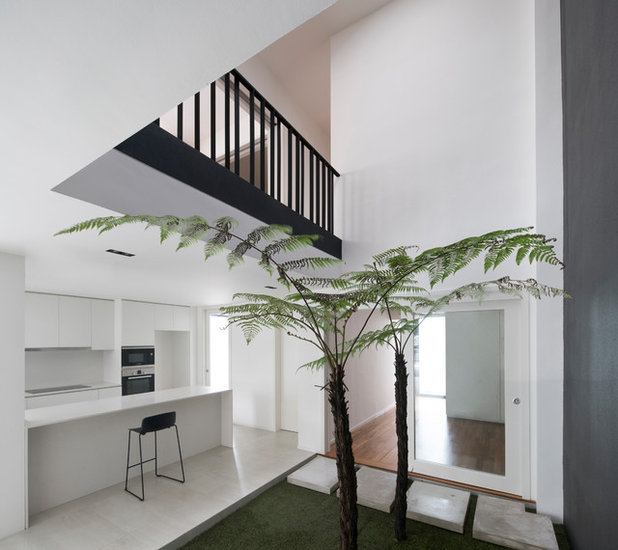
With the extension, older non-structural walls were torn down to open up the interior spaces and rejig the layout of the house. This included reorienting the kitchen so it’s now open-concept. “The lady owner rarely cooks but she did remark once that the new open kitchen, which faces the courtyard and the living/dining area, may inspire her to cook more often for her family,” Ng says.
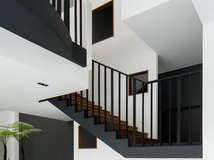
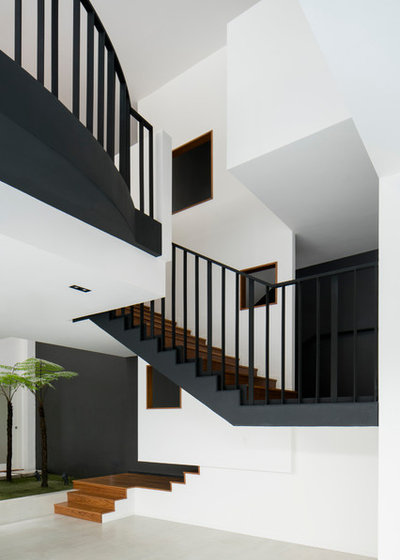
The black and white treatment indoors echoes the exterior colour scheme. “We chose black and white for the articulation of lines (canopies, ledges), surfaces/planes (party walls and parapet walls) and volumes/enclosures (sun-shading devices, rooms),” Ng says.
The black and white treatment indoors echoes the exterior colour scheme. “We chose black and white for the articulation of lines (canopies, ledges), surfaces/planes (party walls and parapet walls) and volumes/enclosures (sun-shading devices, rooms),” Ng says.
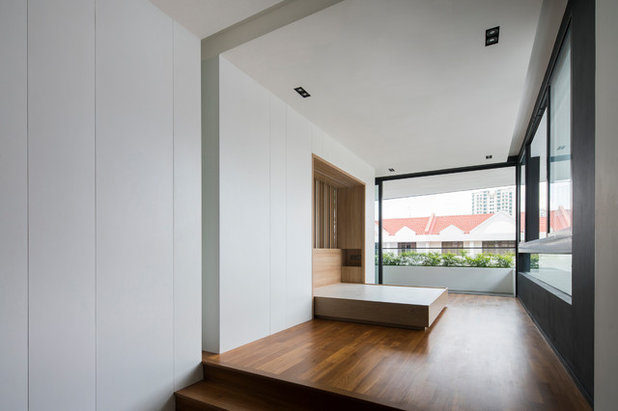
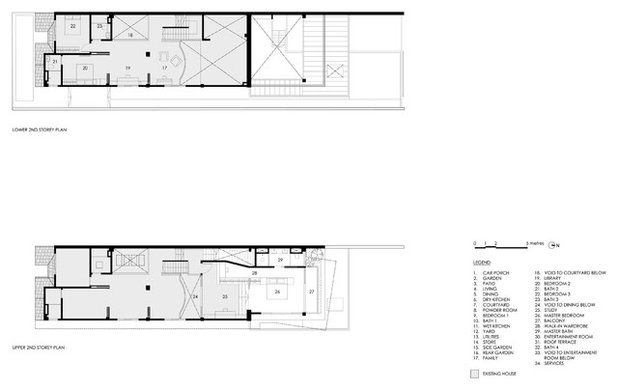
The upper second storey (on the architects’ plans) extension houses the new bedroom area of the master suite which now features an attached study room and walk-in wardrobe, as well as a roof terrace.
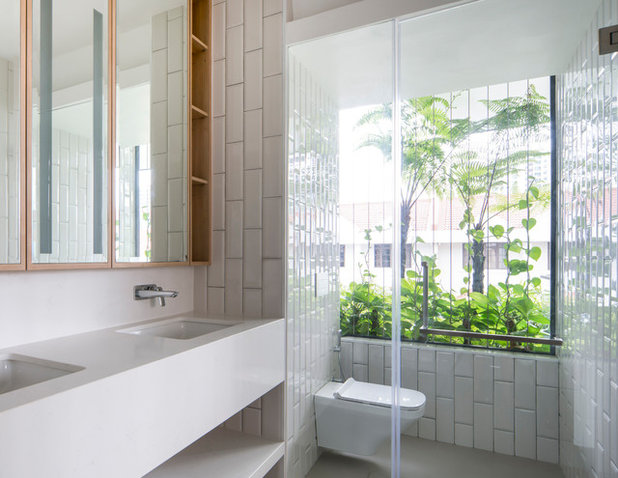
Placed within the ‘gap’ created by offsetting the extension from the party wall is the master bathroom that opens to a lush green view.
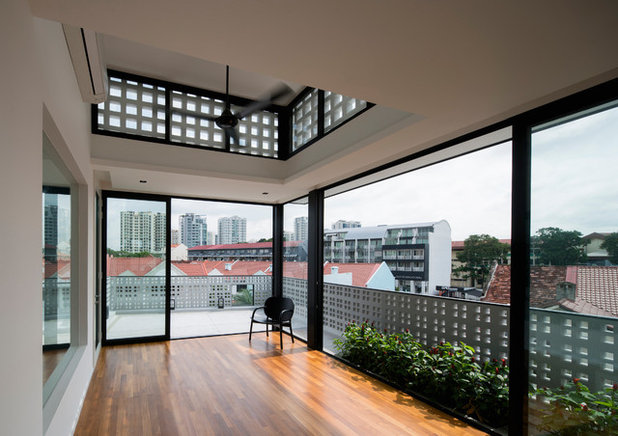
The roof terrace of this level was rotated to face the Singapore Sports Hub, of which the owners now have a view – rather than simply facing the neighbours across their street.
Ventilation blocks used for the exterior parapets double as a medium inspired by pop artist’s Roy Lichtenstein’s use of dots to portray height and depth. Ng says: “The diminishing sizes of the dots were translated into ‘bands’ of ventilation blocks that diminish in size as it rises. Within the ‘bands’, the in-fill ventilation blocks also diminish in size. We adopted ventilation blocks in three sizes, 190 x 190 millimetres (topmost ‘band’), 225 x 225 millimetres (middle ‘band’) and 300 x 300 millimetres (lowest ‘band’) to give the illusion of height and depth.”
“The owners initially had a lot of reservation towards ventilation blocks as it reminded them of institutional buildings and public housing of an earlier era but when they were convinced, they stood by the concept and ensured that it was executed down to the last detail,” he says.
Ventilation blocks used for the exterior parapets double as a medium inspired by pop artist’s Roy Lichtenstein’s use of dots to portray height and depth. Ng says: “The diminishing sizes of the dots were translated into ‘bands’ of ventilation blocks that diminish in size as it rises. Within the ‘bands’, the in-fill ventilation blocks also diminish in size. We adopted ventilation blocks in three sizes, 190 x 190 millimetres (topmost ‘band’), 225 x 225 millimetres (middle ‘band’) and 300 x 300 millimetres (lowest ‘band’) to give the illusion of height and depth.”
“The owners initially had a lot of reservation towards ventilation blocks as it reminded them of institutional buildings and public housing of an earlier era but when they were convinced, they stood by the concept and ensured that it was executed down to the last detail,” he says.
Floor plans: the grey areas on the upper first storey and lower and upper second storey plans indicate the original footprint.
TELL US
What feature did you like best in this home? Share in the Comments below.
What feature did you like best in this home? Share in the Comments below.
What are you working on?
Related Stories
Working with Pros
What is an Architect… And How Do I Work With One?
By Niki Bruce
Get expert advice on why you might need an architect to design your new home
Full Story
Most Popular
Design Vocabulary: Maisonette or Mansionette?
Although no longer produced by Housing and Development Board (HDB), maisonettes are still in demand. Here's why
Full Story
Sustainability
5 Houses With Different Climate-Responsive Screens
Whether it's for sun-shading or promoting natural ventilation, external screens are still the architects' go-to solution
Full Story
How-To Guides
An Architect Tells Us How to Read Floor Plans
Understanding floor plans is a must when building or doing an A&A. Learn how to in the first of our two-part guide
Full Story
Expert Advice
All You Need to Know About Pocket Doors
Get a handle on the smart slide-and-hide solution for versatile spaces
Full Story
StayHome
How Should Singapore’s Built Environment Change Post-Pandemic?
The lessons and issues brought forth by Covid-19 will have an impact on urban planning and the buildings we live in
Full Story
StayHome
How Tuberculosis Pandemics Helped Shape Modernist Architecture
Doctors prescribed sun, air and the outdoors for tuberculosis patients... and it influenced Modernist architecture
Full Story
StayHome
How Will Coronavirus Change our Homes?
Five architects weigh in on how Covid-19 will transform our houses, and share advice on how to make them safer
Full Story
Architecture
‘Breaking Ground’ Celebrates a Century of Women Architects’ Work
More than 200 architecturally significant buildings around the world are featured in architect Jane Hall’s new book
Full Story