


Recent Activity

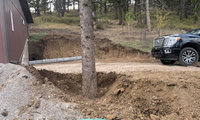

And the extension service - as well as all other reputable sources - will tell you that layering even a small amount of soil (more than an inch or two) over the entire root system can deprive the tree roots of oxygen and smother them, leading to eventual death. I would research this carefully and be cautious about how you proceed.

I've seen just 3-5" of soil kill a trashy norway maple tree in my neighbor's yard (he ignored my warning his contractor had made a mistake, of course!) but it took 4 years of more and more branches dying, until I guess he accepted I was right. 🤣

Yes to all of the above.
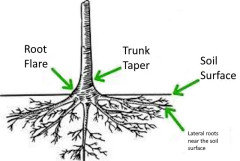
For clarity, I'll post this image to show the basic concept of how things need to be for tree to grow in a healthy manner.
I've personally found out, over the years, how important this is.
The root flare needs to be at or slightly above the surface of the soil.

" Sounds like you could use more in-person contact and social activity? "
What an odd assumption to make.......Why do you think that's so?

"we're very lucky to live in a place where anything will grow, whether it likes water or not. For those types that need regular water, just add it and stand back!".
I'd have to agree with that :)) A fellow horticulturist once told me the reason his plants grew so fast and so large is that he gave them plenty of water. I've experienced similar - water lavishly (with decent drainage) and plants will grow rapidly and lushly.
btw, I have never heard of Machilus thunbergii although I've a passion for less common BLE's. Everyday I discover more about plants and gardening........ even after all these many years.
I researched Machilus thunbergii in the past, since I was interested in broadleaf evergreen trees that could grow in the Pacific Northwest (climate zone 8 ).
It is actually native to Japan. But in Japan, it is sort of seen as an "inferior" version of camphor tree. However, Machilus thunbergii is more cold tolerant than camphor tree, and can grow in colder parts of Japan; although the majority of the population in Japan (such as in Tokyo) lives in areas where camphor trees can grow.
The foliage of Machilus thunbergii reminds one a little bit of some Chinese evergreen magnolia trees (which are rare in cultivation, but not completely unheard of in the U.S.)
There is also "Japanese cinnamon" tree (Cinnamomum tenuifolium) for anyone who is interested (though it is a smaller tree, and evergreen leaves not as pretty).
I don't know why the Japanese would complain - they have plenty of BLEs and a summer wet climate that supports them. The hardiest Cinnamomums are surely as hardy as any Machilus, but they might not be commonly cultivated in Japan. It's actually a little surprising that Japanese gardeners (vs. forest managers or whatever) like camphor trees, because they get so gigantic! I think of gardens there as being smallish.
Honestly, on showiness alone, the flowering Castanopsis of Japan might be prettier than any Cinnamon or Avocado family member! I ONCE AGAIN failed with the Castanopsis seeds Sheffield was offering...not sure what I'm doing wrong, and feel like an idiot at this point. At least I got some other rarities to germinate, like Pinus gerardiana, and Nomocharis aperta. 3 out of 15 seedlings survived in trays this summer, so hopefully I've selected a 'heat tolerant' clone of that Himalayan beauty! (the lily seed was from Jelitto, not Sheffields)
"we're very lucky to live in a place where anything will grow, whether it likes water or not. For those types that need regular water, just add it and stand back!".
Yeah, now, I'm 'used to' a summer wet (usually) climate, which isn't to say I'm not jealous of what people can grow in the PNW. But the problem with a summer wet climate is you can't turn it off! The reason one saw rhododendrons growing near the bottom of swales at Greer Gardens, (or Sonoma Hort for that matter) where they would never be able to survive around here, isn't JUST the cooler nights in summer...it's that because any summer water is water you're turning on, yourself, there's no way to drown them as can happen around here after a hurricane. As I've said before, around Hurricane Irene in 2011, I got close to 30 inches of rain in 40 days. It did kill a few rhododendrons (including a big gorgeous R. rex I'd driven across the country from RSF) but fortunately, most of mine are planted on a gentle slope and it prevented an absolute carnage. They get just enough drainage help from that. This was really a happy accident, when I bought this lot in 2006, I had no idea I'd get 'smitten' by rhodies by driving to Rarefind in NJ that spring. I never knew you could have an 'english looking' rhodie garden in the eastern US. (FWIW Rarefind was on pine barren sand, and had a very sophisticated irrigation system with a deep well and large pump house, so actually closer in that respect to the PNW, than my garden.)
OH well, sorry to take over the thread, but it's interesting to compare gardening practices PNW vs. East coast. I love the summers I can coast by without having to water a damn thing even once, even newly planted stuff. But we pay the price when the spigot won't shut off! (And of course, have to water in dry summers like 2024 and 2025.)

The pine is open grown and limbed up about 10'. I've also done some pruning to allow more sun to reach the site. Where it would be planted receives roughly 5-hours of angled sun, so I think that would be sufficient to grow 'Golden Glow'. This area is also irrigated, with a sprinkler head about 8' from where it would be planted. Gardengal, I believe you've convinced me to proceed. :)
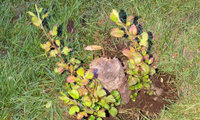
What is currently growing from the stump is whatever pear the rootstock is. If by "cloning" you mean removing the new growth and replanting it to generate a new tree down the road, then yes, it is possible.
But I seem to recall this pear tree is a ornamental, aka callery pear, so generating any new ones by any method is not advised.
Sorry I didn't understand what you said. What is root stock?
It would be really helpful for people who want to help you if you stick to one post about this tree. Then all the information you've given and all the advice you've received will be in one place. The confusion caused by multiple posts is evidenced by both GG and I thinking this was an ornamental pear. Didn't you once say it never fruited?
We could explain what a root stock is but it would be quicker if you just Google the term rather than responders having to type out information which is easily available to you.

I’d describe the band Chicago as somewhere between Kansas and Boston.
tj
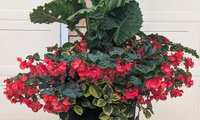
'gg', I think about you lots and your health issues this season. We are all hoping you will be able to do your gardening magic again in 2027.
Thanks of course @lisaam. With no more in ground space I have grown to love doing containers.
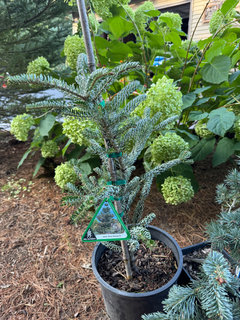
“Seem to be a smaller denser version of Hortsmann Silberlocke.”
That’s not surprising since it originated from a seedling of ’Horstmann’s Silberlocke’. ’Icebreaker’ was also found as a mutation on ’Horstmann’s Silberlocke’. Of these two, ’Silver Show’ will be closer in size and growth rate to Silberlocke.
There’s no right or wrong to planting a larger size, but there is a real sense of satisfaction seeing a small plant slowly make itself into a nice specimen.
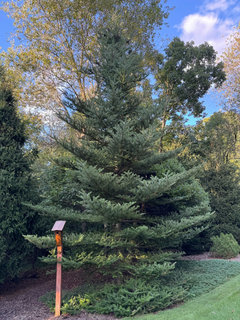
I am fond of all Korean Firs and have several in my garden. Here’s the species:
Horstmann’s Silberlocke:
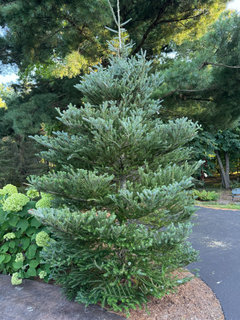
Icebreaker #1:
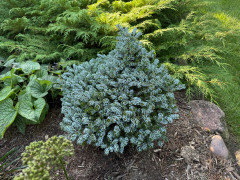
Icebreaker #2:
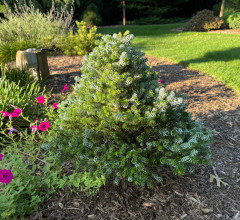
Silver Show: (3gal. yet to be planted)
My favorite is a chopped apple sheet cake. With raisins and walnuts and warm fall spices, it's great with a cream cheese frosting (not too much!). I like baked apples too but they have to be the right kind of apple. I make apple crisp all year round so that doesn't count :-))

I like nearly any of the apple desserts, from apple upside down cake to a sheet cake to pie. I also like Waldorf salad and will have to try that salad of Chloebud's, I have lettuce in my little greenhouse and I like anything with maple in it, yum. I also have about a dozen pears in my refrigerator that are at their peak, that would be good too, and healthier than a Maple Pear Cobbler, LOL.
My favorite way to have apples, though, is to saute them with a little butter and brown sugar and eat them on hot biscuits.
Annie

Annie, those sauteed apples are also great with roasted or grilled pork.😋


This would be fun to try! Made me smile.....the things people come up with!
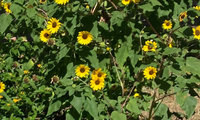
Yes. Most likely Helianthus tuberosus, akaJerusalem artichoke. An aggressively spreading perennial sunflower, it produces edible tubers.
There are many species of sunflowers and not all of them produce those big seedheads and fat, tasty seeds
So I guess some varieties of sunflowers produce small seed pods with seeds that size?
There are many species of sunflowers and not all of them produce those big seedheads and fat, tasty seeds.
"spread somewhat invasively year after year" is what made me guess Helianthus tuberosus. It is a serious spreader/invasive and being perennial, returns year after year.
Both H. tuberosus and H. annuus share a very similar appearance so easily visually mistaken for each other.

I think it's Helianthus anuus. The leaves seem loi large for H. tuberosum. It's annual so it only apprears to be agressive because without deadheading they will be all over the place. The First Peoples to enter the continent selectively bred this annual species of sunflower to produce larger seeds over a period of hundreds or thousands of years. Technically speaking I would say any species in the genus Helianthus is a sunflower. Many other genera in the sunflower family Asteraceae which have yellow ray petals and disk flowers are also called some type of sunflower in their common names. The name Helianthus comes from helios meaning sun, and anthos meaning flower. Sun+flower. You can check the involucre to verify.
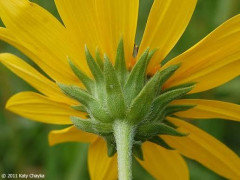
Heianthus tuberosa , Jerusalem Artichoke
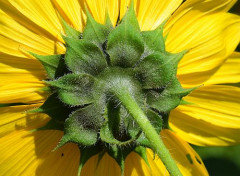
Helianthus anuus, Annual Sunflower.

Sad to admit - I can't sing. But if I were home alone and had the music turned up loud it would be rock - Joan Jett's I Love Rock and Roll, Bob Seger's Old Time Rock and Roll, or anything by Queen.
I think what the great minds of the world need to do is, (1) continue to develop processes that completely break down plastics, some of the work with micro-organisms is interesting, (2) continue to develop fully biodegradable forms of plastic, and (3) when #2 can be scaled cost-effectively, pass laws that ban the use of non-biodegradable plastics with exceptions for situations when a viable biodegradable alternative is not available or not advisable.
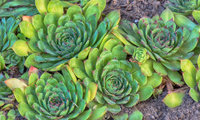
The Common Houseleek, Sempervivum tectorum, is very hardy. I don't think there's any reason to think these are anything else.
The only sterile (non-berry producing) form of ligustrum is L. sinensis 'Sunshine'. The only other reason a ligustrum would not produce berries is lack of pollination. As these are primarily insect pollinated, weather could very well have an impact on that.
'Sunshine' ligustrum has bright yellow leaves and doesn't flower at all. To my knowledge, it is the ONLY sterile form of ligustrum.

Photos might help. Does the fruiting plant's foliage look the same as those that aren't fruiting?
The patch is a mile or two away, so I can't run out and get a photo. But all the foliage looks the same for all the trees. What was striking was that in this one stand, there was just a foot or two of branches with berries.
Sunset at 7:40 here and creeping earlier :-) Not fully dark till after 8-ish.
Our weather in the PNW is typically always mild and this summer has been no exception. Not particularly hot and with our usual summer dryness. The seasons tend to flow gradually into each other and while I can feel a hint of fall in the air, it is not obviously here.....yet.
Fall is my favorite time of year - fall color, cooler temps (no need for fans or AC), harvest time, late season flowers, Halloween, my birthday, cozy food, cozy clothes. I like it all!
Im at Sandridge beach in va with my daughter and her family. The weather is perfect for the beach and for just enjoying the deck with a great view of the ocean. It really cools down at night which is nice. I am looking forward to fall and all that comes with it. Taking a cruise to Canada in October and hoping the leaves with be colorful.

I was surprised hiking the trail today and noticing many fallen leaves. I think that's a little early.
First, there is an entire forum that discusses all these issues in detail. You might find that helpful. https://www.gardenweb.com/discussions/soil
Second, gardeners have differing opinions as to whether compost should be applied over bark, under bark or mixed with bark and incorporated into the soil. Your choice - no right or wrong.
Finally, it is suggested that mulch/compost not cover the crown of perennials. Otherwise, you want to avoid digging mulch or compost into the root system.
That's a good question. I really don't know the technical answer, but I'd probably rake back the mulch and put teh compost right onto the soil, unless the bark has decomposed to the extent that there's little left.
Agree with GG -- keep the compost and the mulch off the crowns.
Ditto. I would pull back the bark mulch, put the compost onto the soil, and replace the bark mulch. And yes, keep the mulch off the crowns.
:)
Dee

According to the Hardy Fern Foundation, Doodia media is hardy to zone 8a. If an unusual cold snap is predicted, they do suggest covering.
https://hardyferns.org/ferns/doodia-media/
I am going to replace it with a Japanese painted fern.


Since there is no legal requirement for the name change, maybe the swing in popularity will cause the more used apps to revert to the proper names for geographic locations....not those made up by some sharpie-wielding man-baby.
I was going to post a time traveling joke but you guys didn't like it.
tj
"Euonymus alatus is regarded as an invasive species of woodlands in the northeastern United States and southeastern Canada, where it can outcompete native vegetation and disrupt local ecosystems. It is currently, since the 1970s, considered an invasive species in 21 U.S. states, and its importation and sale are prohibited in the U.S. states of Maine, Massachusetts, New Hampshire, Pennsylvania, and Vermont."
"It grows in partial shade to full sun in woodland edges, forests, mixed deciduous forests, on roadsides, disturbed areas and any open area where it may expand into a dense grove. It is a prolific seeder and may also reproduce by stem cutting.
The spring flowers are insignificant, but the red fall berries are showy and are consumed by birds and deer, which helps the plant spread beyond cultivated garden areas. Aggressive growth enables it to outcompete other plants. Aggressive growth enables it to outcompete other plants. Its invasive tendency has been noted in multiple midwestern and eastern states from Connecticut to South Carolina and west to Wisconsin.
To control small infestations of burning bush, pull up young plants by hand and use a hoe or root-wrenching tool for large plants. For larger infestations, an herbicide can be applied to the foliage or the stump immediately upon cutting."
NRCS Invasive Plant Control Burning Bush – Euonymous alatus: https://efotg.sc.egov.usda.gov/api/CPSFile/21638/314_VT_OTH_Brush_Management-Burning_Bush_
ONE IDIOT in this neighborhood planted one about 16 years ago - and now I see them starting to pop up in the hedgerows adjacent my property. They are more of a 'northern' shrub and used not to be common in this part of Maryland. (by contrast, several gardens have invasive Nandinas, but I don't see those spreading as much. One family recently removed their Nandina hedge though, maybe because it was seeding in their garden.) Please delete this from your garden!
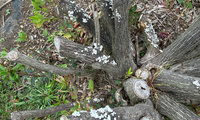
Meanwhile ;-), those white things remain fungal fruiting bodies, most likely Schizophyllum commune.