
Key Measurements to Make the Most of Your Bathroom
Fit everything comfortably in a small or medium-size bath by knowing standard dimensions for fixtures and clearances

Bathrooms come in second to kitchens as places where considerable attention is given to layouts and finishes, and size doesn’t limit the quality of their design. Learning a few key dimensions and common fixture sizes – and understanding that a compact space can work to your advantage – will inspire you to embrace these intimate spaces as opportunities to create unique and delightful rooms.
The most common bathroom layout is the single plumbed wall. All fixtures are lined up and served from one compact source of drains, water supplies and venting. This saves on plumbing installation and provides efficient distribution of heated water, especially when the wall is near a water heater. These walls need to be constructed of 2-by-6 studs, rather than 2-by-4s, mainly to accommodate the larger vent stack for the toilet. Even if your home has a large master bath, it likely has at least one bathroom elsewhere in the house that’s arranged this way.
Tubs. Standard tubs with apron fronts are 60 inches (152 centimetres) long and 30 to 32 inches (76 to 81 centimetres) wide. The depth can be as little as 14 inches (35 centimetres) and as much as 20 inches (50 centimetres).
Toilets. You need at least 30 inches (76 centimetres) of clear width for toilets, but 32 to 36 inches (81 to 91 centimetres) is much better for most people.
Single sinks. For a single sink, you need at least 30 inches (76 centimetres) of width, but 36 to 48 inches (91 to 107 centimetres) is more comfortable.
Double sinks. You can squeeze two sinks into 60 inches (152 centimetres) of width, but 72 inches (183 centimetres) or more is preferred.
Note: Metric dimensions are close translations of U.S. standards and do not represent the standardised dimensions that may apply to your country.
Tubs. Standard tubs with apron fronts are 60 inches (152 centimetres) long and 30 to 32 inches (76 to 81 centimetres) wide. The depth can be as little as 14 inches (35 centimetres) and as much as 20 inches (50 centimetres).
Toilets. You need at least 30 inches (76 centimetres) of clear width for toilets, but 32 to 36 inches (81 to 91 centimetres) is much better for most people.
Single sinks. For a single sink, you need at least 30 inches (76 centimetres) of width, but 36 to 48 inches (91 to 107 centimetres) is more comfortable.
Double sinks. You can squeeze two sinks into 60 inches (152 centimetres) of width, but 72 inches (183 centimetres) or more is preferred.
Note: Metric dimensions are close translations of U.S. standards and do not represent the standardised dimensions that may apply to your country.
Notice that a shower curtain or door has not been installed in this bathroom yet. Carefully consider which you choose. For example, a shower curtain might make taking a bath more comfortable, but a clear glass shower door might make the room feel larger.
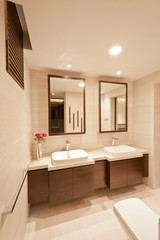
A double vanity makes this bath comfortable for two. Also, the tub is deeper than average. While 5-foot tubs are easy to come by, deeper tubs can be harder to find. If you intend to use it primarily for taking showers, a shallower tub might be best. But if you intend to use the tub frequently, you might want a deeper one for better soaking.
A double vanity makes this bath comfortable for two. Also, the tub is deeper than average. While 5-foot tubs are easy to come by, deeper tubs can be harder to find. If you intend to use it primarily for taking showers, a shallower tub might be best. But if you intend to use the tub frequently, you might want a deeper one for better soaking.
Your bath could be slightly wider than the typical 5 feet. If this is the case, you can install a longer tub or create a niche, as in this design. Another nice touch, also seen here, is to extend the countertop in a shallower depth over the toilet tank. Since counter heights vary from 32 to 36 inches (81 to 91 centimetres), carefully consider whether your fixtures will fit comfortably under an extended countertop. Not only does the tank need to be low enough, but you must be able to remove the lid without obstruction.
Drop-in tubs like this one can work in a standard configuration with three enclosing walls. Since they don’t have an apron front, you can finish the face of the tub with tile, as has been done in this bath. Also, the architect has installed a ready-made medicine cabinet, but had small shelves and trim built around it to add a custom and sophisticated detail. The depth of medicine cabinets needs to be 4 to 5 inches (10 to 13 centimetres) overall and 3½ to 4½ inches (9 to 11 centimetres) on the interior shelves to suit most people. Widths and heights depend on the individual, but most prebuilt medicine cabinets are about 18 inches (46 centimetres) wide and 30 inches (76 centimetres) tall.
You can find shorter and deeper tubs like this, which allow soaking similar to Japanese-style tubs. This configuration employs the leftover space at the end of the tub for a shelf or shower seat.
Should you choose to have a glass enclosure, as in this bath, consider how high you would like to have the glass reach. Showers that have a steam function need to be completely enclosed, as seen here. Otherwise, the top of the glass should reach at least 76 inches (193 centimetres) above the floor. You may want to coordinate the height with the tiles or other wall finishes, or with the height of the windows and doors in the room.
Should you choose to have a glass enclosure, as in this bath, consider how high you would like to have the glass reach. Showers that have a steam function need to be completely enclosed, as seen here. Otherwise, the top of the glass should reach at least 76 inches (193 centimetres) above the floor. You may want to coordinate the height with the tiles or other wall finishes, or with the height of the windows and doors in the room.
Some people never use bathtubs and can do well with having just a shower. This can be advantageous simply because a space designed solely for showering functions more comfortably than one that requires you to stand in a bathtub to shower. In the bathroom in the previous photo, notice that the shower is defined by a glass wall. The floor is flush into the shower area. The shower drain is along the back wall, with a clean and simple rectangular grate. Barrier-free designs employ this method, which is a consideration if you are planning to age in place.
More common is to have a curb to define the shower’s parameters, as in the bath here. This curb is normally 3 to 4 inches (8 to 10 centimetres) high and 4 to 6 inches (10 to 15 centimetres) wide. Though it’s not as sleek as the previous design, practical limitations may make this the better choice for you.
More common is to have a curb to define the shower’s parameters, as in the bath here. This curb is normally 3 to 4 inches (8 to 10 centimetres) high and 4 to 6 inches (10 to 15 centimetres) wide. Though it’s not as sleek as the previous design, practical limitations may make this the better choice for you.
Pedestal, floating or braced sinks like this one can help make a space feel larger. You will easily find fixtures in widths less than 36 inches (91 centimetres). Consider that if you allow 3 feet for the sink and 3 feet for the shower, and if you have a minimum width of 30 inches (76 centimetres) for the toilet, you will have a room that is 8½ feet (2.6 metres) long.
Browse bathroom photos for more ideas
Browse bathroom photos for more ideas
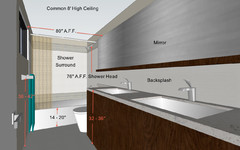
Towel bars can be mounted between 36 and 42 inches (91 to 107 centimetres) above the floor along their horizontal centreline. If you are taller or use extra-large bath sheets, consider raising them to 48 or 50 inches (122 to 127 centimetres). Most ceilings will be 8 feet high in smaller bathrooms. In the sketch shown, the top of the mirror and the top of the tile in the shower align with the top of the window.
In a slight twist on the conventional layout, the toilet and the sink have traded places here. Either arrangement works, but the position of doors can dictate the best solution for you. Consider where doors swing into the room and whether they will open on to a wall or a fixture. A wall is better.
In a slight twist on the conventional layout, the toilet and the sink have traded places here. Either arrangement works, but the position of doors can dictate the best solution for you. Consider where doors swing into the room and whether they will open on to a wall or a fixture. A wall is better.
In other bath layouts, the tub may be opposite the sink and toilet, as shown here. Current U.S. codes require 24 inches (61 centimetres) of clear space in front of a toilet, so be sure to allow for this dimension – and more than the minimum if possible. It is not uncommon to come across configurations that don’t meet minimum standards in older structures. But if you are renovating, be certain to note the toilet dimensions in your project so that you have adequate space.
There are standard-size toilets and elongated configurations. The elongated type will extend into the room by another 2 to 3 inches (5 to 8 centimetres).
There are standard-size toilets and elongated configurations. The elongated type will extend into the room by another 2 to 3 inches (5 to 8 centimetres).
If you wonder how to get a shower and a tub in a very small space, note this example. Placing the sink at the end of the tub and the toilet next to it makes things compact. Niches above the toilet and the use of mosaic tile outside of the shower add subtle contrast and keep everything waterproof – a good idea in tight baths.
When space is extremely limited, you can have a solution like this bathroom. An oval-shaped sink and cabinet are nestled into a concave wall. The toilet is snugly placed next to the shower, but there is enough space to enter and exit through the glass doors. The architects have even managed to insert a conventional medicine cabinet in the niche above the sink.
Sinks will be the most versatile bathroom element with respect to different sizes that can work. Standard tubs are 32 inches wide (81.3 centimetres) and 60 inches (152.4 centimetres) long, but you can find many variations in length, width, depth and shape. Showers are required to have a minimum of 1,024 square inches, which is 32 inches by 32 inches of interior space — although it’s best to aim for at least 36 inches (91.4 centimetres) by 36 inches. Toilets can fit into spaces as small as 30 inches (76.2 centimetres) wide and 54 inches (137.2 centimetres) long, but at least 36 inches wide and 60 inches deep is much more comfortable.
Find bathroom professionals near you
Sinks will be the most versatile bathroom element with respect to different sizes that can work. Standard tubs are 32 inches wide (81.3 centimetres) and 60 inches (152.4 centimetres) long, but you can find many variations in length, width, depth and shape. Showers are required to have a minimum of 1,024 square inches, which is 32 inches by 32 inches of interior space — although it’s best to aim for at least 36 inches (91.4 centimetres) by 36 inches. Toilets can fit into spaces as small as 30 inches (76.2 centimetres) wide and 54 inches (137.2 centimetres) long, but at least 36 inches wide and 60 inches deep is much more comfortable.
Find bathroom professionals near you
Despite the modest dimensions of this space, the custom-designed medicine cabinet stretches over the toilet, providing generous storage. Note that the lighting built into the cabinet is a tall and narrow strip. Lighting fixtures placed on both sides of mirrors are ideal. You want even illumination from each side when grooming, and this arrangement is a good solution.