
Interior Design
How to Plan for Your Lighting Needs
How do you know when you have too little – or too many – lighting fixtures? And where do you place them? Find out here

Lighting can be as easy as buying a new floor lamp or table lamp, placing it next to an armchair or hallway, and you’ve changed the brightness and mood of a space! But it can also be technically difficult – one mistake in placement or the number of lights in your home could lead to a costly and unnecessarily extended renovation because rewiring means having to hack walls or false ceilings. So how do you know which and how much lighting you need, and where to place them?
LIghtcraft also recommends one 20W halogen bulb every two metres or one 35W halogen lamp every three metres in a common corridor.
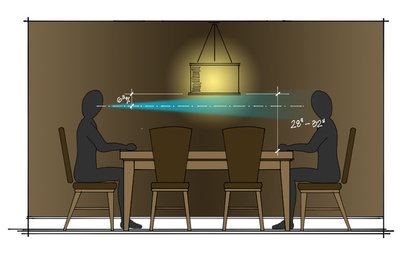
Generally, you need about 150 to 200 lux (the measure of intensity of the bulb) to light a home. Over the dining table, you would like to have at least 250 to 400 lux.
If you prefer CFL (compact fluorescent) downlights, two 13W or one 26W bulbs can replace a 50W halogen downlight. The beam throw of CFLs is wider, however, so the distance between bulbs can be increased by 1.5 times. For homes, two 13W or one 18W CFL downlight is generally adequate.
With those numeric guidelines in mind, here are other factors to consider when planning your lighting:
1. What activities take place in this space?
If you know that your dining room is also going to be used for homework or tuition, then one central pendant light may not be sufficient. You may want to supplement it with a lightweight task light that you can easily move to a corner after the kids are done with their assignments.
Generally, you need about 150 to 200 lux (the measure of intensity of the bulb) to light a home. Over the dining table, you would like to have at least 250 to 400 lux.
If you prefer CFL (compact fluorescent) downlights, two 13W or one 26W bulbs can replace a 50W halogen downlight. The beam throw of CFLs is wider, however, so the distance between bulbs can be increased by 1.5 times. For homes, two 13W or one 18W CFL downlight is generally adequate.
With those numeric guidelines in mind, here are other factors to consider when planning your lighting:
1. What activities take place in this space?
If you know that your dining room is also going to be used for homework or tuition, then one central pendant light may not be sufficient. You may want to supplement it with a lightweight task light that you can easily move to a corner after the kids are done with their assignments.
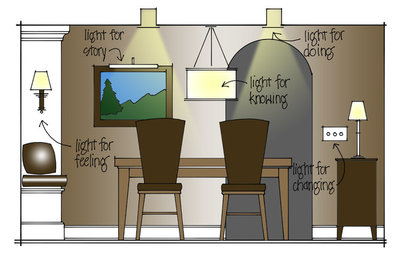
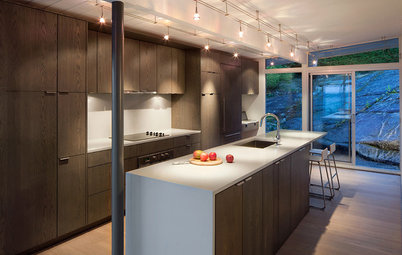
Your activities determine the type of lighting your space needs: ambient, task, or accent.
- General (also known as ambient) lighting is the room’s main illumination. It is usually daylight and your white fluorescent or CFL (compact fluorescent lamp) bulbs.
- Task lighting is a brighter, focused illumination for activities like homework, reading or cooking.
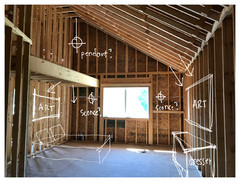
- Accent lighting is decorative and is meant to highlight certain features in a room, like artwork or a dramatic ceiling.
2. Who is using the space?
An older person’s perception of brightness is much dimmer than that of a younger person, as an older person requires a higher level of brightness (industry professionals calls this “lux level”) than someone in their 30s or 40s needs for, say, reading. An older person needs approximately 1,000 lux for reading, whereas a younger person only needs 500 lux.
Lights with a dimmer switch are a good solution for multi-generational homes so that the user can select his/her desired light level.
An older person’s perception of brightness is much dimmer than that of a younger person, as an older person requires a higher level of brightness (industry professionals calls this “lux level”) than someone in their 30s or 40s needs for, say, reading. An older person needs approximately 1,000 lux for reading, whereas a younger person only needs 500 lux.
Lights with a dimmer switch are a good solution for multi-generational homes so that the user can select his/her desired light level.
3. How is the space designed?
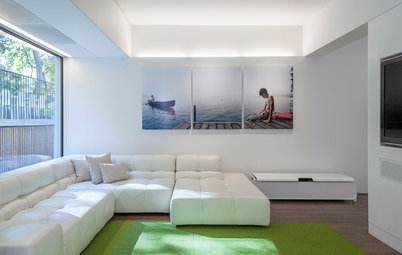
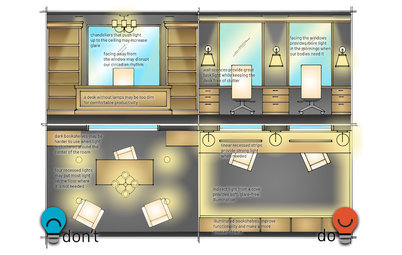
Floor area, ceiling height and surface (floor and wall) finishes all contribute to how much light you need. A higher ceiling will mean that your light bulb may be farther from the object it is meant to illuminate; a lower ceiling may cause you to experience direct glare from the bulb. Dark-coloured walls absorb light, while white walls reflect it. Cement screed, stone and raw brick walls will also absorb light, while glazed homogenous tiles will reflect it.
Floor area, ceiling height and surface (floor and wall) finishes all contribute to how much light you need. A higher ceiling will mean that your light bulb may be farther from the object it is meant to illuminate; a lower ceiling may cause you to experience direct glare from the bulb. Dark-coloured walls absorb light, while white walls reflect it. Cement screed, stone and raw brick walls will also absorb light, while glazed homogenous tiles will reflect it.
4. What mood do you want to create in this space?
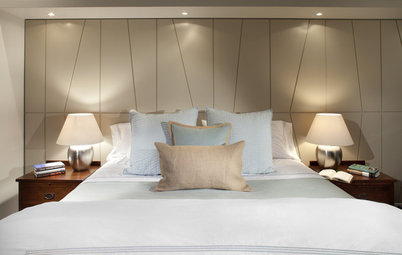
Lighting points provided in an HDB flat or a private apartment are usually adequate for ambient lighting purposes, so all you may need to add is something to change the mood of your space. This means looking at the colour temperature of your lights: a cool white with a colour temperature of about 3,700°C for a living room, a warmer, restful hue of 2,700°C for a bedroom.
Lighting points provided in an HDB flat or a private apartment are usually adequate for ambient lighting purposes, so all you may need to add is something to change the mood of your space. This means looking at the colour temperature of your lights: a cool white with a colour temperature of about 3,700°C for a living room, a warmer, restful hue of 2,700°C for a bedroom.
5. What do you consider visually comfortable?
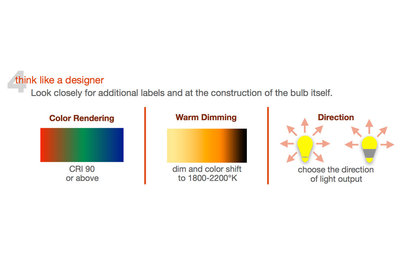
Look colour rendering and glare control when you’re ready to shop for your light bulbs and fittings.
Look colour rendering and glare control when you’re ready to shop for your light bulbs and fittings.
- Colour rendering means that the glow of your light doesn’t affect the real colour of the objects in the room.
- Choose fittings with good glare control, ie, a reflector, diffuser, or shade that reduces the light’s glare.
Ultimately, lighting is a personal and subjective matter. Some people might want the dining room to be bright, but others might prefer it dim and cosy.
TELL US
Is your home adequately lit? How did you plan your lighting? Share with us in the Comments section.
Is your home adequately lit? How did you plan your lighting? Share with us in the Comments section.
View bedroom lighting inspiration